5 min read

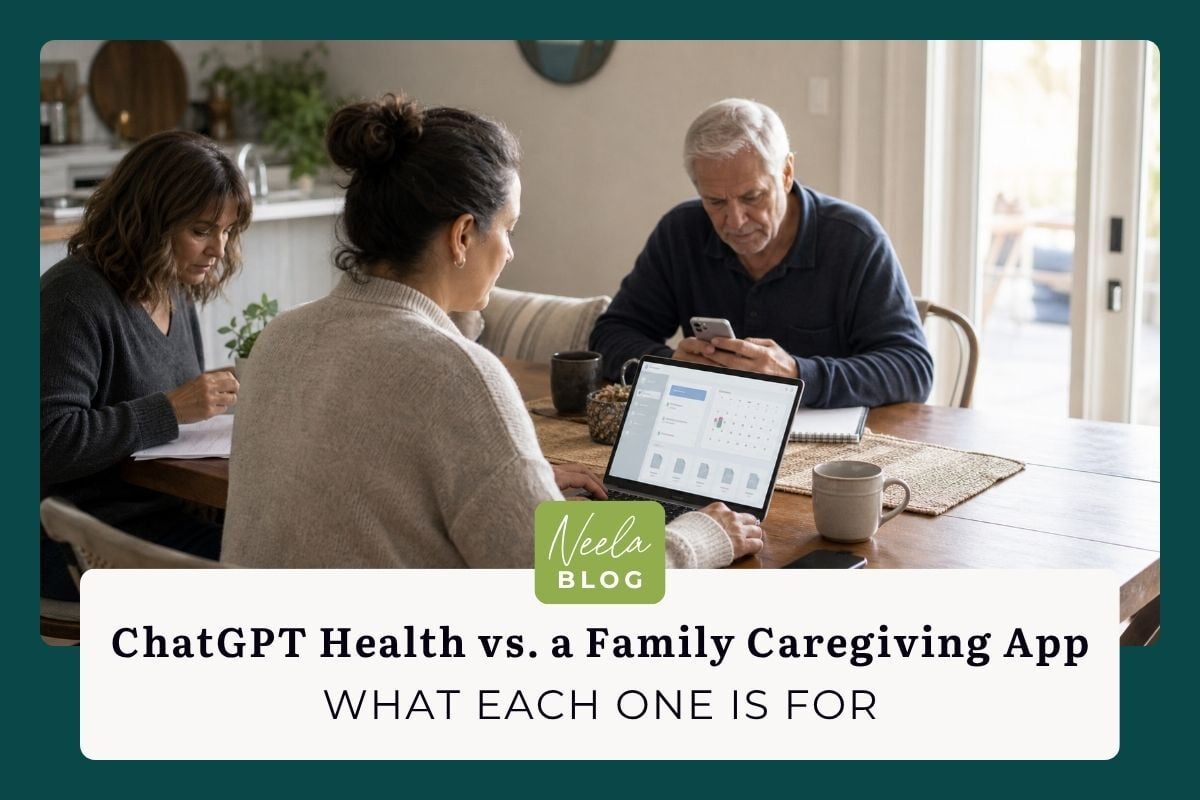
ChatGPT Health vs. a Family Caregiving App: What Each One Is For

ChatGPT Health vs. a Family Caregiving App: What Each One Is For
9:22

Health in ChatGPT is real, it connects to actual medical records, and it is genuinely good at explaining things. It is also built for one person: the individual logged into the account. That single design decision is what separates it from an app made for families managing care together.

Both tools have a place, and most families will end up using both. The useful question is which one to open at which moment, and the answer follows from who each tool was designed to serve.

What Health in ChatGPT actually is

OpenAI announced a limited waitlist version on January 7, 2026 and rolled it out broadly on July 23, 2026 as Health in ChatGPT. It is available to logged-in US users 18 and older, on web and iOS, across the Free, Go, Plus, and Pro tiers.

It connects to real data rather than answering from general knowledge alone. Supported sources include Apple Health, US medical records through a partner called b.well, One Medical, Function Health, and a range of wellness apps. Medical record connections are US only, and they were excluded at launch in the EU and EEA, Switzerland, and the UK.

The demand is not hypothetical. OpenAI reported roughly 230 million people per week asking health questions in January 2026, rising to about 300 million per week by July.

Two things worth knowing before you rely on it. OpenAI states that Health in ChatGPT is designed to support rather than replace medical care, and that it is not intended for diagnosis or treatment. And it is a consumer feature, which means it is not covered by HIPAA. The HIPAA-oriented products, OpenAI for Healthcare and ChatGPT for Clinicians, launched January 8, 2026 and are sold to health systems rather than to families.

The difference that matters most: one account or a care network

Health in ChatGPT is organized around a single logged-in individual and that person's own connected records. There is no shared-access model, no second member, and no way to give your sister visibility into the same information.

For someone caring for a parent, that creates a fork with two uncomfortable branches:

  • Your parent is the account holder, connects their own records, and you have no access to any of it.
  • You are the account holder, which means you are typing your parent's diagnoses, medications, and document contents into your own consumer account, outside HIPAA, and none of it is visible to anyone else helping out.
  • Scribe records a visit on your phone and produces a transcript and a written summary. Audio is not stored, and the feature is mobile only.
  • Vault holds insurance cards, advance directives, and discharge paperwork in HIPAA-compliant storage shared with your care network.
  • Shared tasks and notes, plus a shared calendar, keep everyone working from the same version of events.
  • Medications and Providers keep the active list and the contact details in one place, connected to the appointments they relate to.

Neither branch describes how families actually manage care. Caregiving is usually distributed: one sibling handles appointments, another handles insurance, a third calls to check in. The information has to be shared to be useful.

That is the gap a family caregiving app is built to fill. Neela's care networks hold multiple members by design, so appointments, notes, documents, medications, and providers live in one view that everyone can see. Nobody has to be the family's single point of contact.

Side by side


Health in ChatGPT

Neela

Built for

One logged-in individual

A family managing care together

Who can see it

Account holder only

Every member of the care network (based on permissions)

Connects clinical records

Yes, via Apple Health, b.well, One Medical, Function Health

No, she is a family organizing layer

Shared calendar and tasks

No

Yes

Appointment recording

No

Yes, via Scribe (mobile)

Document storage

No

Yes, HIPAA compliant Vault

General health explanations

Strong

Answers grounded in your family's own context

HIPAA covered

No

Yes

Availability

US, 18 and older, web and iOS

Mobile and web

Cost

Free tier plus paid consumer tiers

$12/mo or $120/yr up to 4 members. $24/mo or $240/yr unlimited


How accurate is general AI on health questions?

Good enough to be useful, uneven enough to verify. Two sources give a realistic picture.

A BMJ Open study published April 14, 2026 tested five chatbots (Gemini, DeepSeek, Meta AI, ChatGPT, and Grok) against 250 health questions. Researchers rated 49.6% of responses problematic, with 30% somewhat problematic and 20% highly so. ChatGPT landed at 52%. Reference completeness averaged 40%, and no chatbot in the study produced a fully accurate reference list.

OpenAI's own benchmark tells a similar story. HealthBench, released in May 2025 and built with 262 physicians across 60 countries, scored the best model available at the time at 0.60 out of 1.0. That is a company measuring its own products and reporting substantial room to improve.

The practical takeaway for a caregiver is not to avoid these tools. It is to treat their answers as a starting point for a conversation with a clinician, and to check anything you plan to act on. A confident tone is not evidence of accuracy, and these models rarely flag their own uncertainty.

When to reach for each one

Open ChatGPT when the question is general. What does ejection fraction mean. What is the difference between types of dementia. What should you expect after a hip replacement. What questions are worth asking a new cardiologist. This is education, and it carries no privacy cost as long as you leave out names and documents.

Open Neela when the question is about your family. What did the specialist say last month. Which pharmacy handles the blood thinner. Who is taking Dad to Thursday's appointment. Neela's Chat answers in plain language using the context she already holds, so you are not re-explaining your situation every time.

A few of the pieces that context comes from:

For official clinical records, your loved one's patient portal remains the source of truth. If their health system uses MyChart, test results and provider messages belong there.

Frequently asked questions

Is Health in ChatGPT free?

There is a free tier. Health in ChatGPT rolled out across Free, Go, Plus, and Pro, so access does not require a paid subscription. The HIPAA status is identical on every consumer tier.

Can I use Health in ChatGPT to manage my parent's care?

Not in a shared way. It is organized around one logged-in account and that person's own connected records, with no way to add a second member. Managing a parent's care through your own account also means putting their health information into a consumer product that HIPAA does not cover.

Is Health in ChatGPT HIPAA compliant?

No. It is a consumer feature, and connecting medical records to it does not create a HIPAA relationship. OpenAI's HIPAA-oriented products, OpenAI for Healthcare and ChatGPT for Clinicians, are separate and sold to health systems.

Is Health in ChatGPT available outside the US?

Not for medical records. The broad rollout covered logged-in US users 18 and older, and medical record connections were excluded at launch in the EU and EEA, Switzerland, and the UK.

How accurate is ChatGPT for health questions?

Useful but uneven. A BMJ Open study published April 14, 2026 rated 49.6% of responses from five major chatbots as problematic across 250 health questions, with ChatGPT at 52%. OpenAI's own HealthBench scored its best available model at 0.60 out of 1.0 in May 2025.

Do I need both ChatGPT and a caregiving app?

Many families use both, because they answer different questions. ChatGPT explains what a condition or a term means. A caregiving app tracks what your family decided, when the next appointment is, and who is handling it.

Can my siblings see the same information in Neela?

Yes. That is the point of a care network. Every member sees the same appointments, notes, documents, medications, and providers, so no single person has to relay updates to everyone else.

How much does Neela cost?

The Core Care Network is $12 per month or $120 per year and supports up to 4 members. The Extended Care Network is $24 per month or $240 per year with unlimited members and priority support. Both start with a 7-day free trial, and no credit card is required.

The short version

Health in ChatGPT is a strong explainer with real access to clinical data, built for one person. A family caregiving app is built for the several people who are actually sharing the work. Use the first to understand, the second to coordinate the day-to-day among your family.

If you want your family's care details in one shared place, from doctor visit summaries to medication lists to appointment notes, Neela can help. Try Neela free for 7 days, no credit card required.

How to Keep Your Whole Family on the Same Page About a Parent's Care

1 min read

How to Keep Your Whole Family on the Same Page About a Parent's Care

When someone you love needs ongoing support, the information adds up fast. Prescription names, specialist phone numbers, post-visit instructions,...

Read More
Is ChatGPT HIPAA Compliant? What Families Need to Know

1 min read

Is ChatGPT HIPAA Compliant? What Families Need to Know

Consumer ChatGPT is not covered by HIPAA. That includes the free version, Plus, Pro, and the Health features that rolled out to US users in July...

Read More
The Role of a Family Member as Caregiver

1 min read

The Role of a Family Member as Caregiver

Family caregiving is rarely a planned role. It often begins with a simple need, helping with appointments, checking in more frequently, or stepping...

Read More