5 min read

Free vs. Paid Caregiving Apps: How They Make Money, and Why It Matters for Your Family

Free vs. Paid Caregiving Apps: How They Make Money, and Why It Matters for Your Family
Free vs. Paid Caregiving Apps: How They Make Money (2026)
7:51

Most caregiving apps are funded in one of two ways. Marketplace apps such as tendercare are free to families and earn revenue from home care agencies, senior living communities, and other providers who pay to appear in a directory. Subscription apps such as Neela charge families directly, generally $10 to $25 a month. Both models are legitimate, and both produce useful products. They produce different products, and the difference shows up in what each app is built to do well.

Families comparing options usually sort by features and price. Funding model is the more useful sort, because it predicts which features get built next and which questions are worth asking before a family commits.

The marketplace model: free to families, paid for by providers

In the marketplace model, the app is free because the revenue comes from the other side of the transaction. Providers pay to be listed, and the app grows by adding both families and providers.

tendercare is a clear example, and the company is straightforward about it. Its FAQ page states that the app is free for families and that revenue comes from paid annual memberships purchased by the professionals in its Trusted Network, who are then marked as "Verified Members." That directory is the center of the business. In April 2026 the company described it as covering more than 441,000 professionals across 20 or more eldercare categories in all 50 states, up from roughly 210,000 providers across 14 categories when the network launched in May 2025. Named partners include Assisting Hands Home Care and Vivo Fitness.

The family-facing side of a marketplace app tends to include genuinely useful free tools, because those tools bring families in. tendercare gives away tenderID, a QR-code fridge decal and wallet card that gives first responders access to a person’s medical information and sends a text alert to family members when it is scanned. The company reported 150,000 social media engagements in the first 24 hours after launch. The app also offers document storage with AI labeling, guided care plans, daily check-ins, a private caregiver community, and help navigating the Medicare GUIDE Program, which the company notes covers more than $2,600 a year in respite care.

What this model does well

  • Real, structured access to vetted local services, which is difficult to assemble on your own
  • No cost, which lowers the barrier for a family in the first weeks of a new diagnosis
  • Emergency preparedness tools that work whether or not anyone opens the app
  • Who defines "verified." The vetting standard is set by the platform, not by an outside body. It is fair to ask what the standard is.
  • Whether non-paying providers appear. If placement is tied to a paid membership, the strongest provider in a given zip code may simply not be listed.
  • Where the roadmap points. A marketplace grows by expanding provider coverage. Day-to-day family features tend to receive less investment over time, because they are not the revenue engine.
  • Depth on the repeating work: appointments, medications, instructions, and who is doing what
  • No referral incentive sitting between the family and the answer
  • A clear cancellation lever, which keeps the product accountable
  • The monthly cost is real. It has to earn its place next to every other family expense.
  • No provider directory. A family actively hiring in-home help will still need to source and vet providers elsewhere.

What to look at closely

None of this makes the model untrustworthy. It makes it a referral business with a helpful app attached, which is a reasonable thing to be as long as families understand what they are using.

The subscription model: families pay, and the product answers to families

In the subscription model, the family is the customer. Revenue arrives from one place, so the product roadmap is set by whether families keep using the app rather than by whether providers keep buying placement.

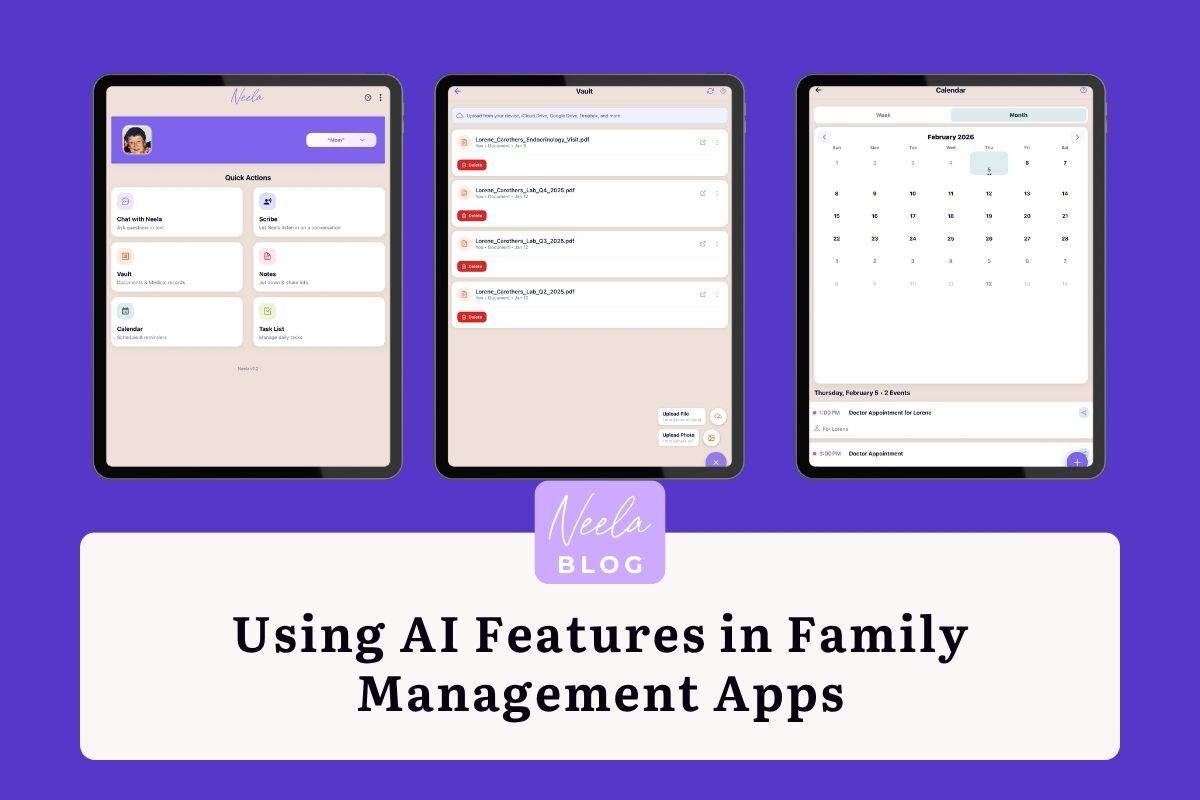
Neela is built this way. Plans run $12 a month or $120 a year for a Core Care Network of up to four members, and $24 a month or $240 a year for an Extended Care Network with unlimited members and priority support. Both include a 7-day free trial with no credit card required. Because the revenue depends on daily usefulness, the features concentrate on the work families actually repeat: Scribe captures a doctor visit and turns it into a written transcript and summary (the audio is not stored), Vault holds documents and test results, and Chat answers questions using the family’s own records rather than general information. Calendar, Tasks, Notes, Providers, and Medications keep the rest of it organized across a care network, on a phone or in any browser.

What this model does well

  • Depth on the repeating work: appointments, medications, instructions, and who is doing what
  • No referral incentive sitting between the family and the answer
  • A clear cancellation lever, which keeps the product accountable

What to look at closely

  • The monthly cost is real. It has to earn its place next to every other family expense.
  • No provider directory. A family actively hiring in-home help will still need to source and vet providers elsewhere.

Five questions worth asking before you commit

  • How does this app make money? Free apps have a payer, and it is worth knowing who it is.
  • If providers pay to be listed, how are they vetted, and do non-paying providers appear in results?
  • Does the app help with the day to day, or mainly with finding services? Those are different jobs.
  • What happens to our family’s information, and who can see it?
  • Does it work on a computer as well as a phone? Some of this work happens at a desk.

Which model fits which family

A family in the first weeks after a diagnosis, or one actively looking to hire in-home help, gets a lot of value from a marketplace app. The directory does work that is genuinely hard to do alone, and it costs nothing to try.

A family that already has help in place, and is now managing appointments, medications, records, and updates across siblings and a partner, will feel the limits of a directory quickly. That family is doing the same handful of tasks every week, and depth on those tasks is what saves them time.

Plenty of families use both, and there is nothing wrong with that. A free directory for finding a physical therapist and a subscription app for keeping the last four appointments straight are solving different problems.

The short version

Free is a price, and it is also a business model. Paid is a cost, and it is also a set of incentives. Neither is a red flag on its own. What matters is whether the app is built to do the specific thing your family needs this month, and knowing who pays for it is the fastest way to figure that out.

FAQ

How do free caregiving apps make money?

Most free caregiving apps are marketplaces. Families use the app at no cost, and revenue comes from providers such as home care agencies, senior living communities, and other services who pay for placement in a directory. tendercare, for example, states on its FAQ page that the app is free for families and that professionals pay for annual Trusted Network memberships.

Is tendercare free?

Yes. tendercare is free for families. According to its own FAQ page, the company earns revenue from paid annual memberships purchased by the professionals listed in its Trusted Network, who are marked as Verified Members.

Are free caregiving apps safe to use?

Free caregiving apps can be safe and useful. The questions to ask are how the app makes money, how provider listings are vetted, and how family information is stored and shared. A clear answer on all three is a good sign, and reputable apps publish that information.

What is the difference between a caregiving app and a home care agency?

A home care agency employs people who provide hands-on help in the home, such as bathing, meals, and mobility support. A caregiving app is software that helps a family organize the information and logistics around care. Some apps also connect families to agencies, but the app itself does not provide hands-on care.

How much do caregiving apps cost?

Marketplace apps are typically free to families. Subscription apps generally run $10 to $25 a month. Neela, for example, is $12 a month or $120 a year for up to four members, and $24 a month or $240 a year for unlimited members with priority support, with a 7-day free trial and no credit card required.

The Mental Load of Caregiving: How to Carry Less Without Doing Less

1 min read

The Mental Load of Caregiving: How to Carry Less Without Doing Less

Learn how to care for yourself as an unpaid family caregiver by using intentional strategies to manage burnout while balancing your family's daily...

Read More
Can a Family Member Get Paid to Be a Caregiver?

1 min read

Can a Family Member Get Paid to Be a Caregiver?

Millions of Americans provide unpaid care to aging parents, disabled spouses, and other relatives every year. Many caregivers reduce their work hours...
Read More
Using AI Features in Family Management Apps

1 min read

Using AI Features in Family Management Apps

Family life runs on a thousand small decisions: who picks up the kids, what's for dinner, when the dentist appointment is, whether there's enough...

Read More