1 min read
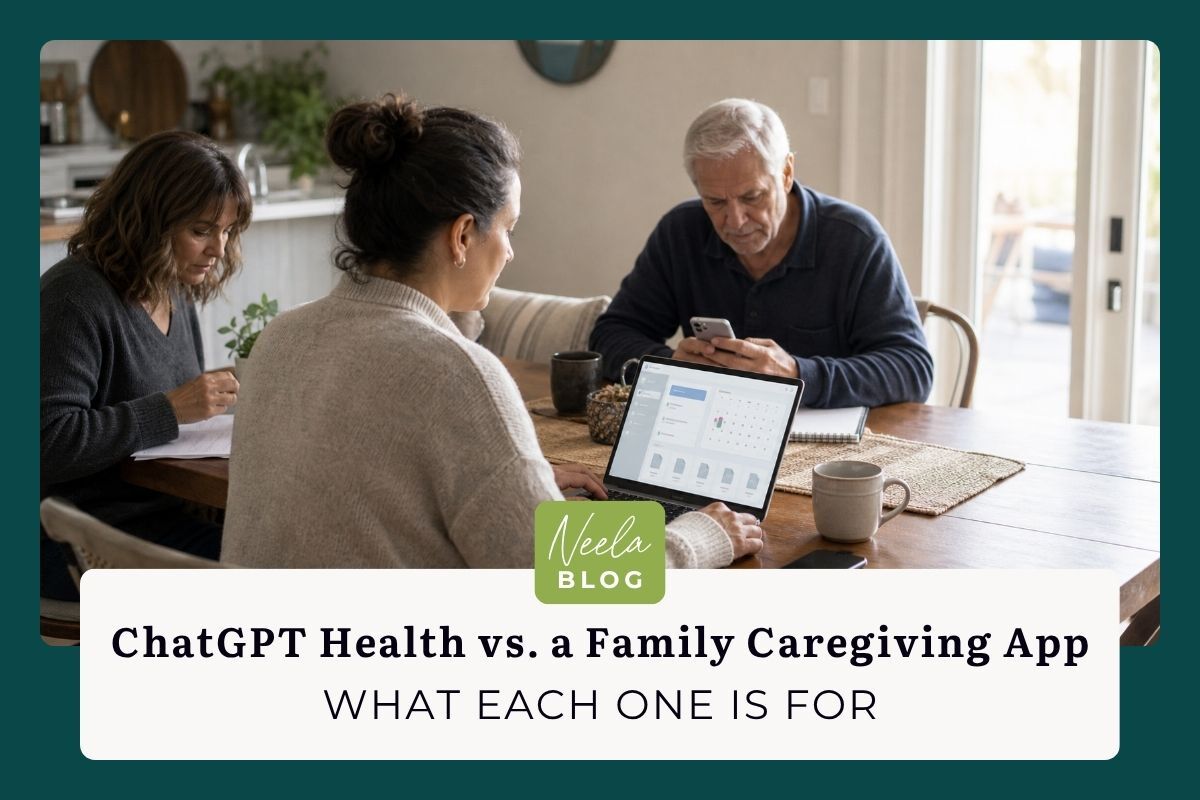
ChatGPT Health vs. a Family Caregiving App: What Each One Is For
Health in ChatGPT is real, it connects to actual medical records, and it is genuinely good at explaining things. It is also built for one person: the...
9 min read
Alexis Villazon : Updated on August 17, 2026
Family caregivers are already doing this. OpenAI reported in July 2026 that around 300 million people a week bring health questions to ChatGPT, and a West Health and Gallup survey released in April 2026 found about one in four United States adults had used an AI tool for health information in the previous month.
The question worth asking is narrower than whether to use it. It is which jobs AI actually does well, and what happens to the answer afterward.
Below are ten prompts built for the person managing someone else's care, not for the patient. Each one comes with two things a prompt list usually leaves out: what the prompt is genuinely good for, and where the answer needs to go so it is still there in three months.
These are the difference between a prompt that saves an hour and one that creates a problem.
Strip the identifiers. Remove full names, dates of birth, insurance member numbers, and medical record numbers before pasting anything. Consumer chatbots are not covered by HIPAA, and what you type is stored under the company's terms of service.
Never ask for a diagnosis, a dose, or an interaction check. These are the answers with the highest cost when the model is wrong, and it is wrong more often than it sounds. Interaction questions go to the pharmacist.
Verify anything you plan to act on. Use AI to understand and prepare. Use a clinician to decide.
Replace the bracketed parts with your own details. The instructions telling the model what not to do are part of the prompt, so leave them in.
I am helping my mother understand her recent blood work. Here are the values and the reference ranges printed on the report: [paste]. Explain in plain language what each one measures and what the reference range means. Do not tell me whether she is sick or what treatment she needs. Then list the questions I should ask her doctor about these results.
What it is good for: Lab reports are written for clinicians. This turns the vocabulary into something readable before the next appointment, without asking the model to interpret her health.
Where the answer goes: Save the plain-language version and the question list somewhere the rest of the family can reach it. Whoever goes to the next appointment should not have to redo this work.
My father has an appointment with his cardiologist on [date]. Since his last visit we have noticed [changes]. His current diagnoses are [list] and his medications are [list]. Write eight questions I could ask, ordered most important first, short enough to read out loud.
What it is good for: Appointments move fast. A ranked list means the important question gets asked in the first five minutes instead of the parking lot afterward.
Where the answer goes: Put the list in your notes before you walk in, and mark the ones that got answered while you are still in the room.
Here is an explanation of benefits from my mother's insurer: [paste]. Explain what was billed, what the plan covered, what we owe, and why. Then describe what a standard appeals process looks like and which documents are usually required.
What it is good for: Billing documents use codes and terms that are not defined anywhere on the page. This is one of the safer uses, because the answer is mostly vocabulary rather than medical judgment.
Where the answer goes: File the explanation with the original document. Billing questions come back months later, and the original alone will not remind you what you figured out.
This is the after-visit summary from my mother's appointment: [paste]. Pull out four things as separate lists: what changed since last time, any new instructions, any follow-up appointments or tests to schedule, and anything that needs to happen in the next seven days.
What it is good for: After-visit summaries bury the actionable parts inside several pages of template text. This separates the paperwork from the to-do list.
Where the answer goes: Every follow-up appointment and test becomes a dated task. This is the step most often skipped, and it is the one that causes the missed referral six weeks later.
Format this into a clean medication list a new doctor can read quickly: [paste]. Use columns for medication, dose, how often, what it is for, and prescribing doctor. Flag anything missing that a doctor would normally want to know. Do not check for interactions or suggest changes.
What it is good for: New specialists always ask for the full list, and the version living in your head is never complete. Formatting is a task AI handles reliably.
Where the answer goes: Keep the list in one place the whole care network can see, and update it the day a prescription changes. For anything about interactions or side effects, call the pharmacist. That is a question for a person with her chart in front of them.
Write a short, calm update to my siblings about today's appointment. Use only these facts: [paste]. Neutral tone, no speculation about what happens next, under 150 words.
What it is good for: The update message is small work that gets skipped at the end of a long day, and skipping it is how one person ends up holding all the information.
Where the answer goes: Send it, then keep a copy where the family can find it later. Text threads scroll away, and the same question gets asked again next month.
My father was recently diagnosed with [condition]. Give me a plain-language overview: what it is, the terms I will start hearing, which specialists are typically involved, and the questions families most often ask early on. Name well-known patient organizations I can read next.
What it is good for: The first week after a diagnosis is mostly vocabulary. A general overview is a reasonable starting point, provided it is a starting point.
Where the answer goes: Check what it tells you against the organizations it names before you act on any of it, then save the version you have verified.
I need to talk to my mother about giving up driving. Here is the situation: [context]. Help me plan the conversation. How to open it, what she is likely to say, and how to respond without it turning into an argument. Give me two different approaches.
What it is good for: Driving, money, and moving are the conversations that go badly when improvised. Rehearsing against a model that will play the other side is genuinely useful preparation.
Where the answer goes: There is nothing to file here, but write down whatever gets decided. Family disagreements about these conversations usually start with nobody agreeing on what was actually said.
Here is everything on my plate for my dad's care right now: [dump everything]. Sort it into three groups: this week, this month, and waiting on someone else. Flag anything with a deadline I may have already missed.
What it is good for: Sorting is the thing AI does best and the thing that is hardest to do from memory at the end of the day.
Where the answer goes: Move the sorted items into a shared task list. A list only you can see is still a list only you can act on.
Help me write a specific question to leave on my mother's nurse line about [issue]. Include the relevant background in three sentences and end with one clear question. Under 100 words.
What it is good for: Vague voicemails get vague callbacks. A specific question with the background attached tends to get a useful answer on the first try.
Where the answer goes: Log the answer when the call comes back, with the date and who you spoke to. This is the record that matters when a different doctor asks what you were told.
A good prompt produces a clear answer. Then the answer sits in a chat window, and the chat window scrolls.
This is the pattern worth noticing. A caregiver decodes a lab result on a Tuesday, and by the following month nobody can find the plain-language version. A sibling asks what the cardiologist said in March. The medication list that was current in the spring is not current now, and the only complete version was in a conversation on one person's phone.
None of that is a failure of the prompt. It is a structural limit of the tool. A chatbot conversation is tied to one logged-in account, holds no records anyone else can open, and is not built to be updated. Even ChatGPT Health, which OpenAI rolled out more broadly in July 2026, is organized around the account holder's own connected records rather than a family member managing care for someone else.
Which is why the third line under every prompt above is the one that matters. Ask the question wherever you like. Put the answer where the people who need it can reach it.
Neela is a family caregiving app built for the part that comes after the question. She holds a shared record that everyone in the care network can open, with the same information in front of all of them.
Notes and Vault hold the plain-language summaries, benefits paperwork, and documents you would otherwise be searching a text thread for.
Medications and Providers keep the current list current, so the version handed to a new specialist is not reconstructed from memory.
Tasks and Calendar turn the follow-ups buried in an after-visit summary into dated items with an owner.
Scribe records an appointment on your phone and produces a written summary and transcript, so what the doctor said is captured while it is being said rather than remembered afterward. Audio is not stored.
Care networks give siblings, a spouse, or a paid aide their own access, so information is not held by one person.
Neela is available on mobile and on the web, and plans start at $12 a month for up to four members.
Try Neela free for seven days.
Consumer AI chatbots are not covered by HIPAA, which applies to healthcare providers, health plans, and their business associates rather than to a general chatbot. Anything typed into one is stored under that company's terms of service and can be subject to legal process. In 2025, a preservation order in the New York Times lawsuit against OpenAI required the company to retain chat logs, including deleted ones, before the order was lifted later that year. A reasonable middle ground is to remove full names, dates of birth, and account or policy numbers before pasting anything, and to keep identifiable records in a system built to hold them.
Accurate enough to be useful for vocabulary and preparation, not reliable enough to act on. A study published in BMJ Open in April 2026 tested five widely used AI chatbots against 250 health questions and rated roughly half of the responses problematic, with about one in five rated highly problematic. Reference accuracy was weaker still, and none of the chatbots produced a fully accurate source list. The practical takeaway is to use it to understand terms and prepare questions, then verify anything you plan to act on with the prescribing clinician or pharmacist.
ChatGPT Health is a feature OpenAI announced in January 2026 and rolled out more broadly in July 2026 to logged-in United States users aged 18 and older. It lets a person connect their own medical records and wellness apps so ChatGPT can reference them. OpenAI states it is designed to support rather than replace medical care and is not intended for diagnosis or treatment. Two limits matter for family caregivers: medical record connections are United States only, and the feature is built around the account holder's own records rather than a family member managing someone else's care.
Not in a way a family can rely on. A chatbot conversation is unstructured, tied to one logged-in account, and not designed as a shared record. Nobody else in the family can open it, appointments and medication changes are not stored as records that can be updated, and documents cannot be filed anywhere retrievable. For a single question on a single day it works well. For a record that several people need to reach over months, it is the wrong tool.
With caution. Research presented at the ACM FAccT conference in 2025 found that general-purpose chatbots responded inappropriately to signs of crisis and failed to recognize some indications of suicidal ideation. Several states, including Illinois, Nevada, and Utah, have passed laws restricting AI systems from delivering therapy or behavioral healthcare. AI can help draft a difficult message or think through a conversation. It is not a substitute for a therapist, a support group, or a friend, and it should never be relied on in a crisis.
Full name paired with date of birth, insurance member or policy numbers, medical record numbers, and Social Security numbers. Requests for a diagnosis, a treatment recommendation, a dosage, or a medication interaction check also belong elsewhere, because those are the answers with the highest cost when the model is confidently wrong. Interaction questions go to a pharmacist, who has the full medication list and the chart.
Yes, for a specific set of jobs. AI is dependable at reformatting, summarizing, translating jargon, sorting, and drafting. Those tasks make up a real share of the paperwork around caregiving, and they are the tasks least likely to go wrong. The failure pattern is not that caregivers use AI. It is that useful answers stay in a chat window nobody else can open and are gone by the time they are needed.
OpenAI, Launching Health in ChatGPT, July 23, 2026.
OpenAI, Introducing ChatGPT Health, January 7, 2026.
BMJ Open, audit of five AI chatbots across 250 health questions, published April 14, 2026.
West Health and Gallup, survey of 5,660 United States adults, released April 15, 2026.
Moore, Haber et al., presented at ACM FAccT, June 2025, on large language models and mental health support.
United States Department of Health and Human Services, HIPAA covered entities and business associates.
Illinois Public Act 104-0054 (Wellness and Oversight for Psychological Resources Act), effective August 1, 2025.
Complete the form to receive notifications when new blogs are posted. You will only receive an email once a month!
1 min read
Health in ChatGPT is real, it connects to actual medical records, and it is genuinely good at explaining things. It is also built for one person: the...
1 min read
Consumer ChatGPT is not covered by HIPAA. That includes the free version, Plus, Pro, and the Health features that rolled out to US users in July...
1 min read
Explore how AI can support caregiver mental health as what the research says reveals promising ways to manage emotional burnout and complex daily...