1 min read
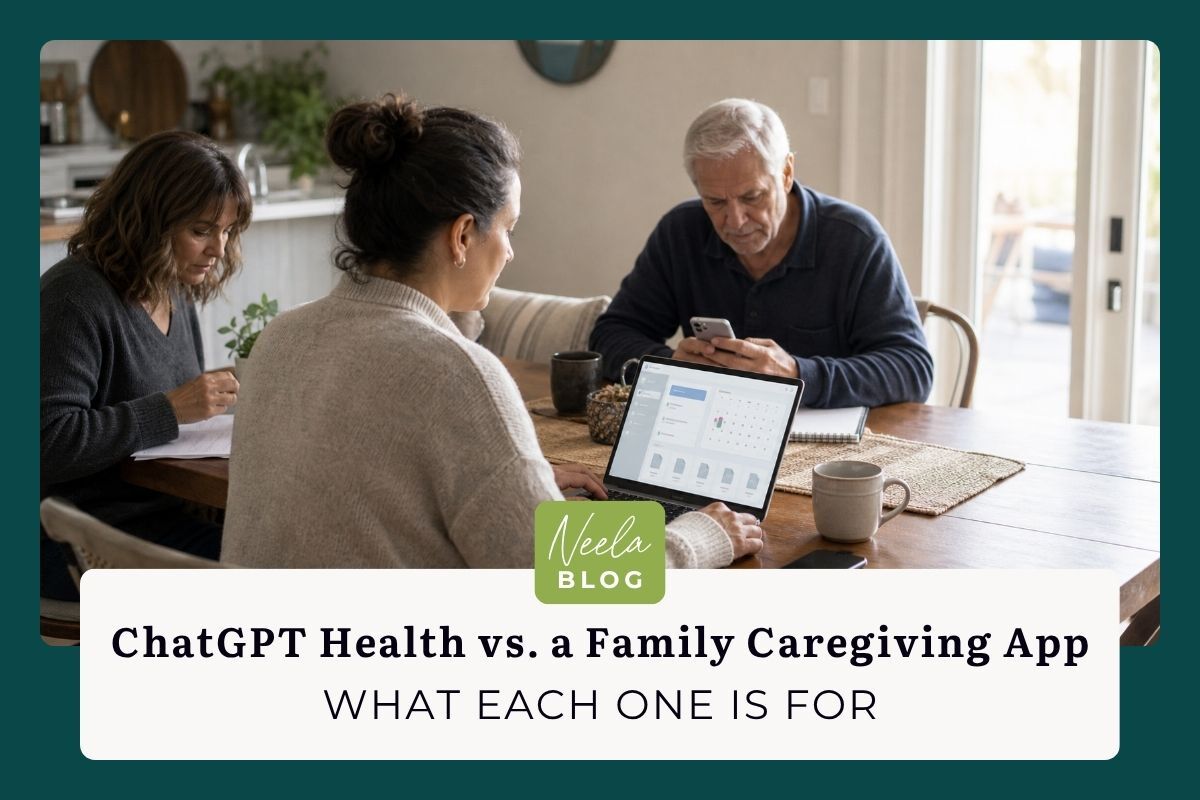
ChatGPT Health vs. a Family Caregiving App: What Each One Is For
Health in ChatGPT is real, it connects to actual medical records, and it is genuinely good at explaining things. It is also built for one person: the...
5 min read
Alexis Villazon : August 13, 2026
ChatGPT Health is a feature inside ChatGPT, officially called Health in ChatGPT, that connects to your actual medical information and answers questions about it in plain language. OpenAI announced a limited waitlist version on January 7, 2026 and opened it broadly on July 23, 2026.
It is worth understanding clearly, because it is genuinely useful for some things and genuinely wrong for others. Here is what it does, what it connects to, what it will not do, and how it fits if you are helping manage someone else's care.
It is a consumer feature, available to anyone logged into ChatGPT in the US who is 18 or older, on web and iOS. It works across every tier including Free, and also Go, Plus, and Pro.
The difference from asking ChatGPT a general health question is that Health in ChatGPT can pull in real data about you. Rather than explaining what an A1C is in the abstract, it can look at yours.
Demand for this was already enormous before the feature existed. OpenAI reported roughly 230 million people per week asking health questions in January 2026, rising to about 300 million per week by July. The company also acquired Torch, a startup working on what it described as unified medical memory, and that team joined to work on ChatGPT Health.
Five categories of source, as of launch:
Apple Health, for step counts, sleep, heart rate, and anything else your phone or watch already tracks
US medical records, through a partner company called b.well, which brokers connections to health systems
One Medical, the primary care provider owned by Amazon
Function Health, a lab testing subscription service
Wellness apps, a range of third-party fitness and tracking tools
The medical records piece is US only. At launch, record connections were excluded in the EU and EEA, Switzerland, and the UK. If you are outside the US, you can use ChatGPT for health questions, but you cannot connect a health system to it.
OpenAI is direct about this, which is useful. The company states that Health in ChatGPT is designed to support rather than replace medical care, and that it is not intended for diagnosis or treatment.
That framing is worth taking literally, because the accuracy picture is mixed. A BMJ Open study published April 14, 2026 tested five chatbots (Gemini, DeepSeek, Meta AI, ChatGPT, and Grok) against 250 health questions and rated 49.6% of responses problematic, with 30% somewhat problematic and 20% highly so. ChatGPT landed at 52%. Reference completeness averaged 40%, and no chatbot in the study produced a fully accurate reference list.
OpenAI's own benchmark agrees. HealthBench, released in May 2025 and built with 262 physicians across 60 countries, scored the best model available at the time at 0.60 out of 1.0.
So treat it as a very good explainer and a starting point for questions you bring to a clinician. A confident tone is not the same thing as accuracy, and these models rarely flag their own uncertainty.
Better than most people assume, with one important gap.
The published terms: health conversations are not used to train OpenAI's foundation models, connected records are not used for training or for ad targeting, and disconnecting a data source deletes the synced data within 30 days.
The gap is that none of those are HIPAA obligations. Health in ChatGPT is a consumer product and it is not covered by HIPAA. HIPAA applies to health care providers, health plans, and the business associates they contract with, and OpenAI is not acting as any of those when you use the consumer app. The commitments above are company policy, which can change or be overridden by a court.
The HIPAA-oriented products exist, and they are separate. OpenAI for Healthcare and ChatGPT for Clinicians launched January 8, 2026 and are sold to health systems and clinicians, not to families.
Search for this and you will hit several unrelated products with confusingly similar names. Quick guide:
• Stanford HealthGPT is an open-source experimental iOS research app from Stanford Biodesign Digital Health that queries Apple Health data. It is a research project, not a commercial product, and it has no connection to OpenAI.
• Carbon Health is an urgent care chain that launched GPT-4 powered clinician charting in June 2023. It is a tool for the people writing your chart, not for you.
• Stanford Health Care Secure GPT is an internal, HIPAA-cleared tool for Stanford Medicine staff. Not available to the public.
None of these are the thing your neighbor was talking about. That is almost certainly Health in ChatGPT.
Here is where it gets complicated, and where most coverage of this feature skips a step.
Health in ChatGPT is built around one logged-in account and that person's own connected records. There is no shared access and no second member. If you are managing a parent's care, that leaves two options, and neither is great:
Your parent holds the account and connects their own records, and you cannot see any of it.
You hold the account, which means you are typing your parent's diagnoses, medications, and document contents into your own consumer product, outside HIPAA, where nobody else helping out can see it either.
That second option is the one people default to, and it is worth pausing on. The identifiers that turn a general question into a health record are easy to include without thinking: a name, a date of birth, a diagnosis tied to a person, a provider's name, or anything pasted from a document.
This matters because caregiving is rarely a solo job. Adoption data backs that up. Caregiving in the US 2025, from AARP and the National Alliance for Caregiving, counts 63 million caregivers in the US, and 55% now use at least one form of technology in the role. West Health and Gallup found that about one in four US adults had used an AI tool for health information in the previous 30 days, while only 4% said they strongly trust its accuracy. People are using these tools and staying appropriately skeptical, which is the right instinct.
Split it by what kind of question you are asking.
General questions go to ChatGPT. What does ejection fraction mean. What is the difference between palliative care and hospice. What should we expect after a hip replacement. Leave out names and documents and there is no privacy cost.
Questions about your specific family go somewhere built for a family.
Neela's Chat answers in plain language using the context she already holds, so you are not re-explaining your situation every time. A few of the places that context comes from:
Scribe records a visit on your phone and produces a transcript and a written summary. Audio is not stored, and the feature is mobile only.
Vault holds insurance cards, advance directives, and discharge paperwork in HIPAA-compliant storage shared with your care network.
A shared calendar, plus tasks and notes, so your brother in Denver sees the same information you do without you typing it out from a parking garage.
Medications and Providers keep the active list and the contact details connected to the appointments they relate to.
For official clinical records, your loved one's patient portal is still the source of truth. If their health system uses MyChart, lab results and provider messages belong there.
There is a free tier. Health in ChatGPT rolled out across Free, Go, Plus, and Pro, so it does not require a paid subscription. The privacy and HIPAA status are the same on every consumer tier.
No. It is a consumer feature, and connecting your medical records to it does not create a HIPAA relationship. OpenAI's HIPAA-oriented products, OpenAI for Healthcare and ChatGPT for Clinicians, are separate and sold to health systems.
Not in any shared way. It is organized around a single logged-in account and that person's own records, with no option to add a second member or grant a family member access.
Not for medical records. The rollout covered logged-in US users 18 and older, and record connections were excluded at launch in the EU and EEA, Switzerland, and the UK.
No, according to its published terms. Health conversations are not used to train foundation models, and connected records are not used for training or ad targeting. These are company commitments rather than legal requirements.
Useful but uneven. A BMJ Open study published April 14, 2026 rated 49.6% of responses from five major chatbots as problematic across 250 health questions, with ChatGPT at 52%. OpenAI's own HealthBench scored its best available model at 0.60 out of 1.0 in May 2025.
Health in ChatGPT is a real product, free to try, US only for records, not covered by HIPAA, and built for one person. It is very good at translating medical language into something you can act on, and it is not a place to store your family's care information.
If you want your family's health details, appointments, and daily tasks in one shared space, Neela was built for that. Try Neela free for 7 days.
Complete the form to receive notifications when new blogs are posted. You will only receive an email once a month!
1 min read
Health in ChatGPT is real, it connects to actual medical records, and it is genuinely good at explaining things. It is also built for one person: the...
1 min read
Consumer ChatGPT is not covered by HIPAA. That includes the free version, Plus, Pro, and the Health features that rolled out to US users in July...
1 min read
Family caregivers are already doing this. OpenAI reported in July 2026 that around 300 million people a week bring health questions to ChatGPT, and...